

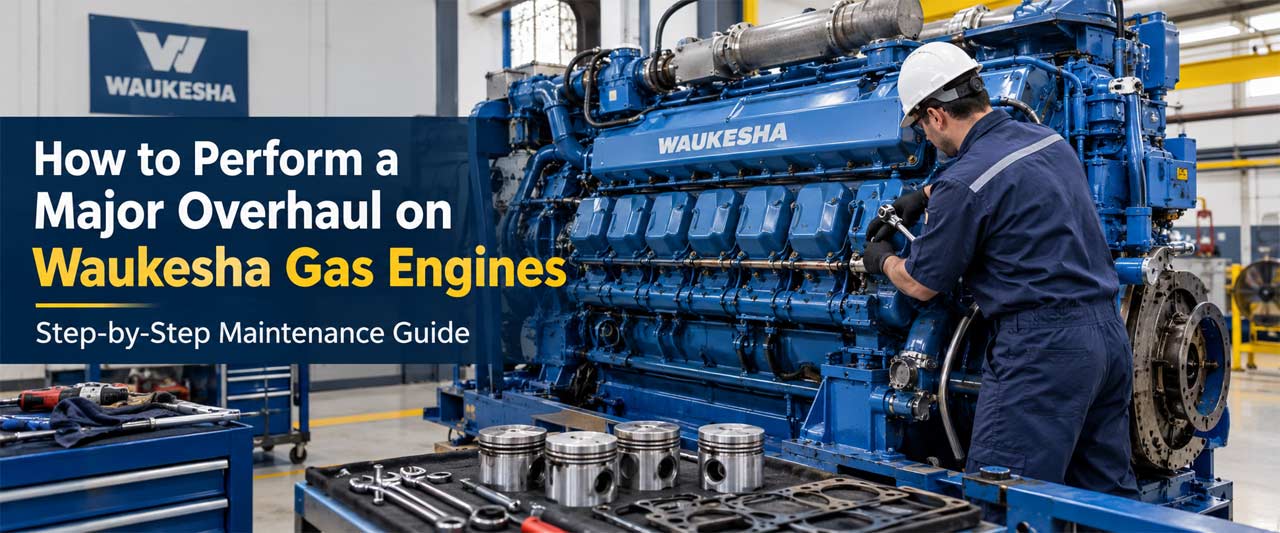
A major overhaul is a process that is carried out intentionally and not by instinct. It is a procedure that is meant to restore an engine to its designed state and should be followed step by step to yield desirable results. This article contains all the necessary steps to major overhaul Waukesha gas engines in addition to the indicators that are used by experienced technicians to identify the need for a major overhaul.
Overhaul Definition and Scope
A major overhaul typically involves a comprehensive inspection and replacement of major worn parts. While a scheduled maintenance may consist of a valve job, inspection of the valve train and cylinder heads and the replacement of a valve kit, a major overhaul will typically seek to dismantle and reassemble an engine while also replacing all worn parts. The following, therefore, are some of the key differences between a scheduled maintenance and a major overhaul:
• A major overhaul is normally carried out on a calculated distance or operating hours basis.
• A major overhaul typically covers a larger scope of work than a top-end or in-frame overhaul. In addition to addressing the cylinder and valve trains, it will also address the crankshaft and main bearings.
• A major overhaul requires additional planning in relation to parts and labor before starting the process.
It is important that the technician always refers to the engine manual and the manufacturer’s guidelines for a Waukesha engine overhaul in order to avoid assumptions when it comes to the technical aspects of the overhaul process.
Steps Involved in Overhauling Waukesha Gas Engines
Planning the Overhaul
Planning is an important activity to carry out before overhauling an engine and should not be overlooked. The following are some of the reasons why planning is important:
• Determining the overhaul scope in relation to the operating hours or distance and the recommendations by the manufacturer for a specific engine model.
• Identifying and purchasing the necessary spare parts to avoid having to halt the process midway due to a shortage of materials.
• Recording baseline information on the engine performance to help inform the evaluation process after repairs and to ensure conformity with the expectations of the manufacturer.
• Allowing enough time for the overhaul process by estimating the required labor with a fair degree of accuracy. A lot of time is unnecessarily wasted due to people underestimating the time required to complete a task.
Preparation
The following are some of the preparations that should be carried out before starting the process of dismantling an engine:
• Switching off the engine and carrying out the necessary steps to ensure that safety is maintained throughout the process.
• Draining all the fluids and removing any unnecessary components before dismantling the engine.
• Cleaning the engine casing to avoid introducing contaminants into the engine during the dismantling process.
• Having the necessary tools and equipment at the worksite and preparing a layout to avoid misplacing components during the course of the overhaul process.
Disassembly and Inspection
The process of dismantling an engine should be accompanied by recording all observations. It is advisable to carry out inspection and recording of observations as opposed to dismantling the entire engine and then carrying out tests. The following are some of the activities that should be carried out when inspecting an engine:
Cylinder Heads and Valve Trains
The following should be carried out when inspecting the cylinder heads and the valve trains:
• Removing the cylinder heads in accordance with the recommended torque sequence and instructions in the manufacturer manual. The heads will then be examined for cracks or deformations that may prevent their reuse.
• The valve plates, seats, springs and guides will also be inspected for indications of normal wear and tear that would be anticipated with a scheduled valve job that would have been carried out on a regular basis. This information can also be compared to records on similar maintenance work if it is available.
• Examining the valve guides’ clearances and the condition of the valve seats in accordance with the recommended specifications.
• The cylinder heads will be examined for cracks or deformations that may prevent their reuse. This is an important step that should be carried out before deciding whether to reuse or condemn cylinder heads.
Pistons, Rings and Liners
The following activities should be carried out when inspecting the pistons, rings and cylinder liners:
• Removing the pistons and ensuring that they are placed in the correct position in order to indicate the cylinder from which they were removed. This information may be important at a later stage when it will be necessary to identify the specific cylinder that is faulty.
• Examining the overall condition of the pistons for indications of scoring, cracks or excessive wear at the ring land.
• Measuring the ring gap and comparing it to the recommended specifications.
• Examining the cylinder liner for scoring, out-of-round, tapering or other forms of irregularities.
• Measuring the diameter of the cylinder liner at several points and in different planes since it is unlikely that there will be uniform wear throughout.
Crankshaft and Main Bearings
The following activities should be carried out when inspecting the crankshaft and main bearings:
• Checking the main and connecting rod bearings for indications of scoring or abnormal wear.
• The bearing clearance will then be measured against the recommended specifications.
• Inspecting the journals for scoring or out-of-round indications.
• Checking the crankshaft runout if it is required to inspect the entire crankshaft.
Camshaft and Timing Components
The following activities should be carried out when inspecting the camshaft and timing components:
• Checking the condition of the camshaft lobes and determining whether abnormal scoring or pitting exists.
• Checking the timing chain or gear backlash and condition.
• Examining the bearings and bushings that support the camshaft.
Component Reconditioning or Replacement
Based on the results of the inspection, it will be necessary to decide on the components that will need to be reconditioned or replaced. Components that were found to be within acceptable limits but that exhibited signs of progressive wear can either be renewed as part of a major overhaul or be placed on a list for renewal at a later stage depending on the philosophy of the maintenance organization. On the other hand, components that were found to be out of specifications should not be renewed since this can compromise the entire purpose of a major overhaul.
Wear items are normally renewed as standard practice and may include piston rings, main and rod bearings, gaskets and seals. However, it is likely that the decision to renew these items will be made based on a visual inspection even though these components may not be within the specified limits. Components such as the cylinder liners and the crankshaft may require machining services at a certified machine shop and should, therefore, be considered when developing the scope of a major overhaul.
Reassembly
Reassembly is the most critical phase of a major overhaul because it determines the success or otherwise of the entire process. Even the most meticulous inspection and documentation will not yield desirable results if the reassembly process is not carried out correctly. The following are some general aspects of reassembly:
• Always refer to the recommended torque sequence and specifications when reassembling the engine. It is important not to guess the torque specifications of a specific component based on experience or common practice.
• Always use new gaskets and seals since it is not always easy to evaluate the condition of a gasket by simply looking at it. If a gasket has been used in a previous overhaul and shows signs of distortion, it should not be reused. This is because the integrity of the gasket cannot be determined visually with a fair degree of accuracy.
• Clearance checks should always be carried out before the final tightening of the bolts or nuts in order to ensure that they conform to the recommended specifications.
• Installing the piston and rings should always be done in accordance with the recommended ring gap and staggering.
• Always tighten the cylinder head in accordance with the recommended torque sequence and stages.
• Always use new gaskets and seals since it is not always easy to evaluate the condition of a gasket by simply looking at it.
Timing and Valve Clearance
The timing should be set in accordance with the recommended specifications for the specific engine model. The valve clearances should also be set in accordance with the specified clearances.
Pre-Startup Checks
These checks should always be carried out before starting an overhauled engine in order to detect any anomalies that could compromise the entire process. The following are some of the checks that should be carried out:
• Always confirm the correct torque values for all the nuts and bolts before finalizing the reassembly process.
• Always ensure that all the tools and equipment that were used during the overhaul process are removed from the engine compartment after reassembly.
• Checking fluid levels including oil, coolant and fuel to confirm that they are within the recommended levels before starting the engine.
• Confirming that all the safety systems and monitoring equipment have been installed and are functioning correctly.
• It is advisable to manually rotate the engine if it is possible in order to ensure that everything moves freely before starting the engine.
Startup and Break-In
The engine should be started and its general condition assessed. The following are also important considerations:
• The oil pressure should always be checked immediately after starting the engine. If the readings are not within the recommended limits, it will be necessary to stop the engine and investigate the cause of the problem.
• The engine should be broken in on a reduced load in accordance with the recommended specifications for the specific engine model.
Checking Performance against Specifications and Recording Data
After completing the break-in process, it will be necessary to evaluate the overall performance of the engine. The following are some of the considerations:
• Comparing the results of the tests to the baseline information gathered before the start of the major overhaul. This will provide a good indication of the condition of various engine components including the cylinder, valve trains and the crankshaft. The results should also be compared to the specifications recommended by the manufacturer. If test results do not conform to the recommended specifications, it will be necessary to investigate further to identify the problem.
• It is always advisable to document all the test results and make a record of all the activities that took place during the overhaul process.
Common Mistakes and Challenges
The following are some of the common mistakes that should be avoided when carrying out a major overhaul:
• Failing to document all the observations and findings made during the process of dismantling the engine and inspecting its components.
• Failing to replace components that were found to be slightly out of specifications in order to prolong the time between two consecutive overhauls.
• Always assuming that torque specifications are interchangeable when, in reality, they are specific for each component.
• Failing to conduct the necessary break-in procedures before subjecting the engine to full load.
• Inadequate planning when sourcing for spare parts which can result in unplanned downtime waiting for the required components to arrive at the jobsite.
Finding the Right Parts for Waukesha Overhaul Jobs
The following considerations should be put into practice when sourcing for the right parts for a Waukesha overhaul:
• Always confirm that the part number matches the recommended parts list for the specific engine model being worked on.
• Always acquire gasket sets, bearings and other components from suppliers who are familiar with Waukesha engines and are able to provide the correct components for the specific engine model.
• Advance planning should be carried out when sourcing for spare parts to avoid project delays. This is particularly important when ordering imported spare parts.
Considerations Specific to Pakistan
The following considerations should be taken into account when planning a major overhaul in Pakistan:
• Since the lead-time on imported spare parts dictates the timeline for major overhaul jobs, it is always important to carry out advance planning when sourcing for spare parts.
• It is important to identify and shortlist potential machine shops that can carry out special machining jobs such as boring, turning and honing.
• Since the temperatures in Pakistan can sometimes be extremely high, it is always advisable to plan major overhaul jobs in a way that avoids working in extremely hot weather.
• Since a large proportion of Waukesha engines may be located in remote areas and not within city limits, it is important to factor in logistical constraints when developing the overhaul schedule.
Conclusion
A major overhaul of a Waukesha engine is a complicated procedure that requires a lot of effort. Experience has shown that skipping some of the steps or making mistakes at certain stages of the process can come at a great expense at a later stage. It is for this reason that it is important to carry out proper planning and documentation at every stage of the process. By adhering to the manufacturer’s specifications and using the correct torque values, a major overhaul will yield desirable results and increase the period between two consecutive overhauls.
If you need spare parts to carry out a major overhaul on a Waukesha engine, you can browse through the wide range of available options at gencomspares.com.pk or contact us to help you source the parts you need.